National-3CPERS CII-GRC Platform
Sahana Eden-aligned humanitarian and emergency information-management architecture, adapted to CII/GRC and cyber-incident context.
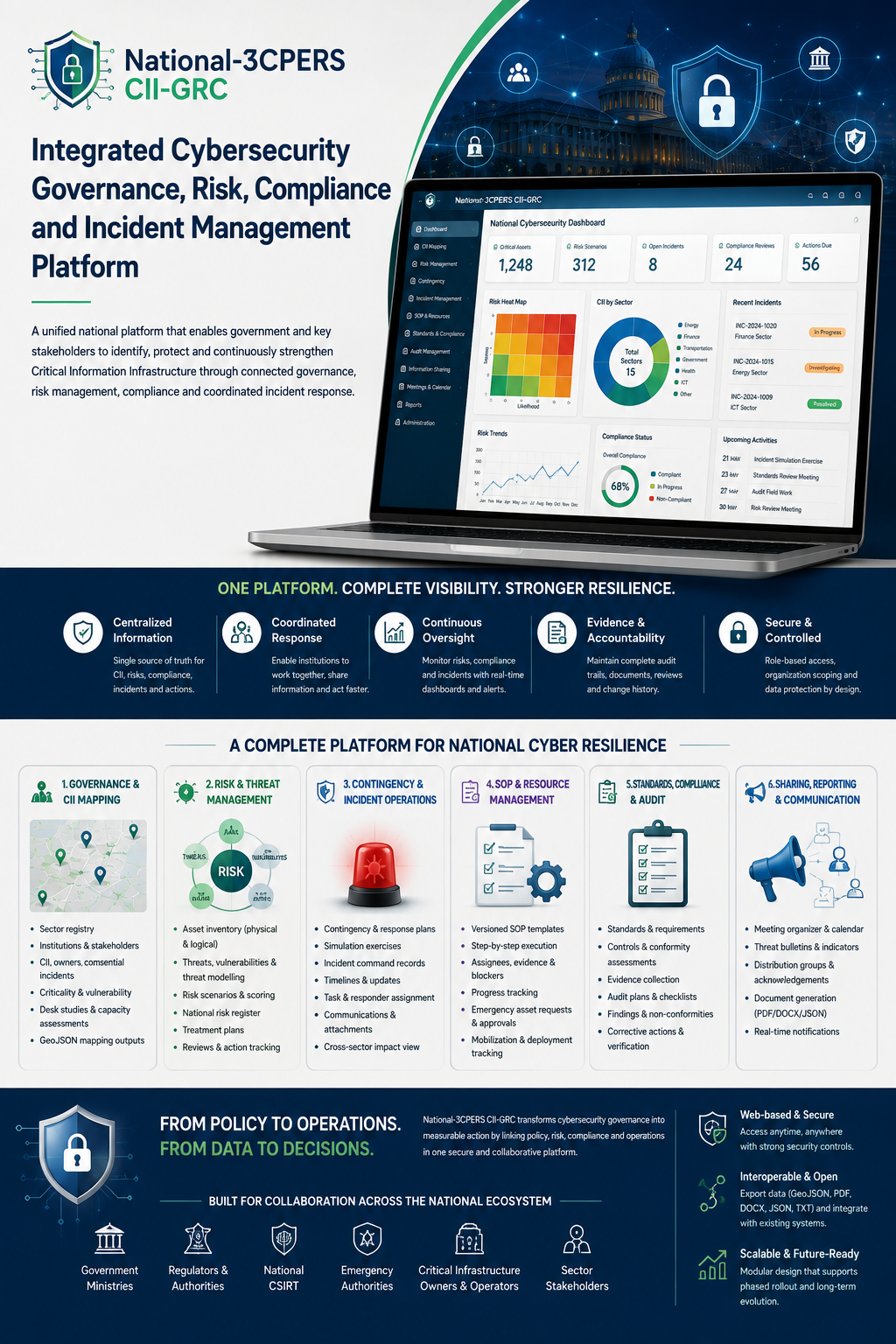
National-3CPERS CII-GRC is an integrated national cybersecurity governance, risk, compliance and incident-management platform designed to support the identification, protection and continuous monitoring of Governments' Critical Information Infrastructure.
Demo booking coming soon
About this product
National-3CPERS CII-GRC is a comprehensive cybersecurity governance platform designed to help governments protect, manage and continuously strengthen their Critical Information Infrastructure (CII). Built on a Sahana Eden-aligned information management architecture, the platform provides a centralized, secure and collaborative digital environment where government authorities, regulators, national CSIRTs, emergency management organizations, critical infrastructure operators and other stakeholders can coordinate cybersecurity activities while maintaining a trusted national repository of information.
The platform unifies the management of critical infrastructure by connecting sectors, institutions, essential services and strategic assets with cybersecurity risks, vulnerabilities, threats, contingency plans, compliance requirements and operational activities. It enables governments to maintain an accurate understanding of their national cyber landscape through structured data management, continuous monitoring and coordinated governance processes, ensuring that all critical information remains linked throughout its lifecycle.
National-3CPERS addresses the challenges created by fragmented cybersecurity information spread across disconnected systems, documents and communication channels. By consolidating infrastructure inventories, risk records, compliance evidence, contingency plans, audit documentation and incident information into a single governed platform, it provides decision-makers with a reliable source of truth that supports informed policy, operational coordination and long-term resilience planning.
Designed around government operational processes, the platform structures cybersecurity governance through standardized workflows, centralized registries and collaborative processes that improve coordination between ministries, regulators, emergency response organizations and critical infrastructure owners. Every action, assessment, review and operational activity is recorded within a controlled environment that preserves accountability through role-based permissions, organization-level data separation, audit trails, document versioning and lifecycle management.
The solution provides operational decision support through executive dashboards, workflow boards, interactive maps, searchable registries, calendars, alerts and comprehensive reporting capabilities. These tools enable government leaders and operational teams to monitor national cybersecurity posture, coordinate ongoing activities, track programme delivery and maintain situational awareness across multiple sectors and organizations from a single interface.
During cybersecurity incidents, National-3CPERS serves as a centralized coordination platform that supports incident management, operational communication, response planning and resource coordination. It enables government organizations to maintain structured response records, coordinate stakeholders, manage operational activities and document every stage of incident response and recovery within a unified operational environment.
A core strength of the platform lies in its comprehensive information governance capabilities. Reports, supporting evidence, reviews, document versions, snapshots and change histories are managed throughout their lifecycle, providing institutions with complete traceability while supporting oversight, regulatory compliance and long-term institutional knowledge. Its open architecture also facilitates interoperability with existing government systems through standards-based services and multiple export formats, enabling seamless data exchange and future integrations without compromising security or governance.
Built as a modular and scalable solution, National-3CPERS can be progressively deployed across ministries, regulatory authorities, national cybersecurity agencies and critical infrastructure operators. Its flexible architecture allows governments to expand capabilities over time while maintaining a unified governance framework, ensuring that cybersecurity management evolves alongside institutional, operational and regulatory requirements.
Key features
Governance, institutions and CII mapping
- Sector registry. - Stakeholder/institution profiles. - CII owner designation. - Essential services. - Criticality, vulnerability, NDA and mission-assurance fields. - Desk studies; governance artifacts. - Capacity assessments. - GeoJSON mapping.
Continuous risk and threat methodology
- Physical/logical asset inventory. - Threat events; vulnerabilities. - Threat modelling links. - Structured risk scenarios. - Likelihood, impact and score. - National risk register. - Reviews, treatment plans and action tasks.
Contingency and incident operations
- National/sector contingency plans. - Emergency asset readiness. - Simulation exercises. - Incident command records, timelines, updates, assignments, tasks, communications, attachments and cross-sector impacts.
Executable SOP and resource allocation
- Versioned SOP templates and ordered steps. - Activation against a live incident. - Step-level assignees, evidence, blockers and completion ratios. - Emergency asset request, approval, mobilization, deployment and release.
Standards, conformity and audit engine
- ISP/banking/CNI standards. - Requirements and controls. - Conformity assessments. - Control evidence. - Audit plans and checklists. - Findings, non-conformities, corrective actions, verification and recurring reviews.
Coordination, sharing, reporting and security
- Meeting/call organizer and calendar. - Threat bulletins and indicators - Distribution groups, information shares and acknowledgements. - Document generation. - Realtime in-app notifications. - IAM, RBAC, organization scoping and audit trails.
Why choose this product
The platform provides decision-makers with a comprehensive national cockpit that delivers real-time visibility into operational activities, critical risks, infrastructure mapping coverage, compliance progress, incident response status and program delivery milestones. It strengthens coordination between government institutions and critical infrastructure stakeholders by centralizing meetings, assignments, notifications, communications and acknowledgements within a shared operational environment. Through continuous assessments, integrated security controls, executable standard operating procedures, simulation exercises and emergency resource management, the platform helps improve the resilience of Critical Information Infrastructure while ensuring preparedness for cyber incidents. It also supports governance and oversight with structured documentation, version-controlled records, audit-ready evidence and comprehensive reporting throughout the review lifecycle. Built on a secure and scalable architecture, the platform uses organization-based data segregation and role-based access control to support the progressive onboarding of ministries, regulators, sector operators and Critical Information Infrastructure owners.
Use cases
The platform provides governments with a comprehensive environment for strengthening national cybersecurity governance. It enables institutions to build and maintain a centralized map of Critical Information Infrastructure (CII), identifying critical sectors, operators, essential services and strategic assets while assessing their criticality and vulnerability. It supports continuous cyber-risk management by linking asset inventories with threat intelligence and vulnerabilities to evaluate, prioritize and monitor risks throughout their lifecycle. During cyber incidents, the platform facilitates coordinated response by managing incident command, assessing cross-sector impacts, activating standard operating procedures, coordinating responders and supporting recovery operations. It also streamlines the development, implementation and auditing of cybersecurity standards by managing compliance requirements, evidence collection, conformity assessments and corrective actions. Finally, it strengthens collaboration across the national cybersecurity ecosystem by supporting stakeholder engagement, threat communication, training and exercise planning, program management, and the continuous review and versioning of strategic initiatives.